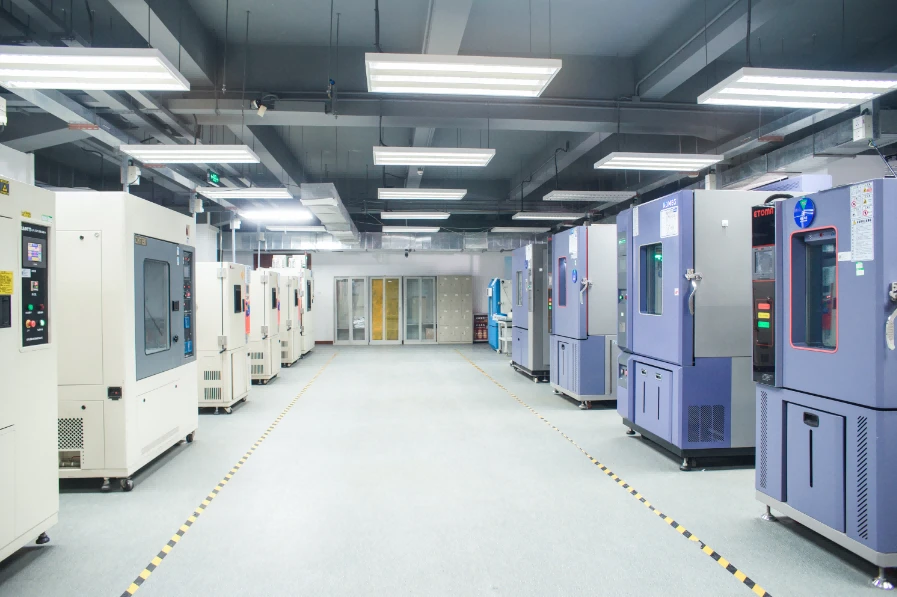
In the field of equipment-reliability engineering, a common saying goes, "Sweat in the lab before going to war." It means pushing a product to its limits in the laboratory before it ever reaches the market. Temperature-and-humidity environmental reliability testing is one of the core tools for achieving this goal. GRGTEST's Environment & Reliability Center, with a nationwide network of 18 laboratories and nearly 20 different sizes of test chambers, continues to provide one-stop verification services for the automotive, appliance, medical, and defense industries.
Why perform temperature-and-humidity testing?
High humidity forms water films on PCBs, plastic parts, and encapsulants, causing swelling, ion migration, leakage currents, and even dendritic shorts. High temperatures accelerate material aging, solder creep, and metal oxidation. Exposing these issues early can significantly reduce field-failure rates and maintenance costs.
2. How we test ?
Test categories
• Steady-state damp heat: constant temperature and humidity to assess long-term moisture resistance.
• Cyclic damp heat: periodic temperature/humidity changes to simulate day–night or transport/storage conditions.
• Combined temperature/humidity cycling: superimposed vibration or electrical stress for comprehensive accelerated-reliability verification.
Typical profiles
• 85 °C / 85 % RH ("double-85") for 1000 h-long-term aging for LED, PV, and automotive electronics.
• −40 °C ↔ +85 °C, 20 % ↔ 95 % RH, 10 cycles-meets ISO 16750-4 road-vehicle requirements.
Standards matrix
GB/T 2423, IEC 60068, MIL-STD-810, GJB 150/360/548, VW 80000, GMW 3172, etc.-full coverage of military, commercial, and automotive specifications.
3. Capability overview
• Equipment scale: 18 m³ walk-in chambers, 5 K/min fast-transition chambers, −70 °C dew-point de-humidification systems.
• Service footprint: local sample drop-off in 18 cities (Guangzhou, Wuxi, Shanghai, Beijing, etc.) with nationwide networked reporting.
• Accreditations: CNAS, CMA, ship-classification approvals, military qualifications, and dual recognition from major OEMs.
4. Application snapshots
• Automotive ECU: after 30 cyclic damp-heat cycles, functional drift < 2 %, satisfying a 10-year warranty model.
• Medical power supply: 168 h at 40 °C / 93 % RH under rated load with no breakdown, exceeding IEC 60601-1 safety margins.
• Satellite communication module: 1000 h at 85 °C / 85 % RH per MIL-STD-883 K, Method 1004.8; RF insertion-loss change ≤ 0.1 dB, ensuring 15-year orbital life.
5. Execution flow
Requirement confirmation → test-plan design (profile, cycles, checkpoints) → sample pre-conditioning → in-situ functional monitoring → failure analysis → corrective-action proposal → re-test closure.
6. Customer value
• Obtain military, automotive, and commercial multi-standard reports in one pass, cutting certification cycle time by more than 30 %.
• Leverage GRG's multi-disciplinary expert team for concurrent failure analysis and material characterization to pinpoint root causes quickly.
• Nationwide integrated quality control with cloud-based data sharing enables "zero-delay" re-testing across sites.
Conclusion
As new-energy vehicles, autonomous driving, and low-altitude economy sectors grow, products face increasingly harsh climate profiles. GRGTEST is committed to helping customers "keep risks in the lab and take trust to the market" through professional temperature-and-humidity environmental reliability testing.