Background of photoaging tests
The material or product has a negative impact on the climate, leading to premature product failure. Consumers spend billions of dollars every year to maintain degraded products and update expired ones, with the most significant aging being caused by exposure to sunlight.
The photoaging test mainly uses artificial light sources to simulate the solar spectrum (including ultraviolet, visible, and infrared light, etc.) to reproduce the destructive light waves that exist in different environments, and accelerates aging by controlling temperature and moisture, helping companies quickly understand the changes in products and materials exposed to sunlight, providing corresponding data support for scientific research, product development, and quality control, helping companies choose new materials, improve product durability, and optimize material durability formulas.
What is the purpose of photoaging tests
Verify whether it meets the expected quality objectives in research and development, design, and manufacturing, in order to evaluate the overall product and determine its reliability life.
What are the types of photoaging tests? How should I choose?
Simulating the real lighting environment and using artificial accelerated photoaging methods can achieve the goal of quickly evaluating material properties. The main methods used include ultraviolet light aging test, xenon lamp aging test, carbon arc light aging test, and metal halide lamp test.
|
Test type |
Optical wavelength |
Testing standards |
Testing standards |
|
UV Aging Test |
290nm-400nm |
GB/T 16422.3(equivalent and GB/T4892.3),GB/T 18950,ASTM G 154ASTM D-4674,ASTM_D4674,JIS K 7350 etc. |
The power distribution of shortwave spectra is minimally affected by time, which can improve the authenticity and repeatability of testing. |
|
Xenon lamp aging test |
400nm-800nm |
GB/T 16422.2(equivalent and GB/T4892.2),GB/T 8427,GB/T 1865ASTM D4355,ASTM G155,JIS K5600,etc. |
Xenon lamps perform well in simulating long wave ultraviolet and visible light bands, with a focus on color changes during testing. Xenon lamps are usually used. |
|
Carbon arc aging test |
300nm-700nm |
GB/T 16422.3(equivalent and GB/T4892.3),ASTM G153,JIS D 0205JIS B 7753,etc. |
The test chamber has the disadvantages of high maintenance costs, inability to calibrate, and narrow simulated spectral range, and has now been gradually phased out. |
|
Metal halide lamp test |
280nm-3000nm |
GB 2423.24,IEC60068-2-5,DIN75520,etc. |
The spectral distribution of metal halide lamps is very similar to the sunlight received on the Earth's surface. Due to the large scale of metal halide lamps, they are mainly suitable for artificial light aging acceleration testing of large equipment such as automobiles, their components, and electrical and electronic products. |
GRGTEST service capability
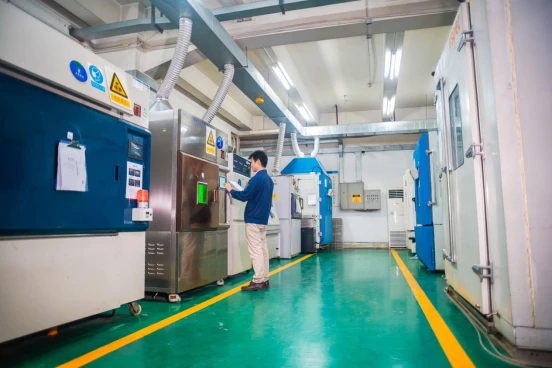
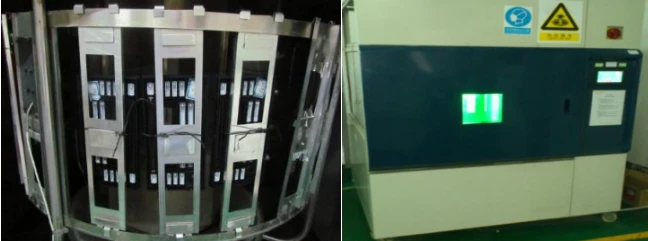
The GRGTEST Environment and Reliability Laboratory has CMA/CNAS and other qualifications, implements a nationwide integrated control mode, actively participates in various capability verification projects, and ensures that the test results are fair, accurate, and traceable. There are 16 testing laboratories across the country, equipped with high-end testing instruments and equipment such as xenon lamp aging testing machine, solar radiation testing machine, solar carbon arc testing machine, fluorescence ultraviolet aging testing machine, etc., for light aging testing of household appliances, automotive parts, power tools, information technology equipment, medical equipment, power equipment, cable trays, wireless products, electrical accessories and other products.
Test equipment