

Traditional HTOL testing relies solely on single high-temperature simulations, failing to replicate the complex operating conditions of real vehicles. This results in "lab-conforming data but production failures," wasting R&D investments and delaying market launches, thereby becoming a critical bottleneck hindering the commercialization of automotive-grade chips.
As an authoritative third-party testing platform certified by multiple ministries including the Ministry of Industry and Information Technology and the National Development and Reform Commission, GRGTEST has specialized in automotive-grade chip reliability verification for years. Moving beyond empirical judgment, we adopt the AEC-Q100 standard as our core methodology, employing scientific models: Through Arrhenius kinetic models combined with precise calculations of silicon device activation energy (0.7eV) and Boltzmann constant (8.6×10⁻⁵eV/K), we integrate laboratory high-temperature accelerated testing data with real-world vehicle environmental parameters to accurately predict chip lifespan. This approach helps manufacturers preemptively address critical issues like "passing test specifications but experiencing real-world failures." To date, we have validated over 100 models including MCUs, AI chips, and security chips, produced nearly 900 AEC-Q and AQG324 certification reports, and facilitated mass production for more than 100 automotive-grade components.
Want to know how to accurately match a chip's 15-year service life through high-temperature testing at 125°C? The following section breaks down the manufacturer's proprietary "chip lifespan prediction methodology" using specific computational examples!
High-temperature acceleration model:
Arrhenius model
Core principle: Considering only the accelerating effect of temperature stress on failure, derived from the Arrhenius equation in chemical kinetics:
Formula and parameters:
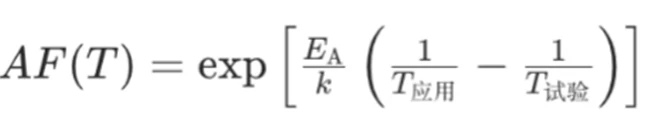
AF(T): Temperature acceleration factor (unitless)
EA: Activation energy (typically 0.2–1.4 eV for silicon devices, with 0.7 eV being the standard value)
K: Boltzmann constant (8.6×10⁻⁵ eV/K)
T Application: Actual operating temperature (unit: K)
vT application: Accelerated test temperature (unit: K)
Example: A vehicle-grade chip with an estimated service life of 12,000 hours over 15 years operates at an average junction temperature of 87°C. Given a maximum temperature limit (HTOL) of 125°C, how many hours of operation would be required?
Specify input parameters:
Actual usage duration: T = 12,000 h (average operating time corresponding to 15 years)
Actual operating junction temperature: T = 87°C (to be converted to Kelvin K)
Test temperature: T = 125°C (to be converted to Kelvin K)
Activation energy: EA=0.7 eV (typical activation energy for chip operational life failure)
Boltzmann constant: k=8.6×10⁻⁵ eV/K
Temperature conversion (Kelvin K):
The required temperature is the thermodynamic temperature (Kelvin). Conversion formula: T(K) = T(°C) + 273.15
Actual junction temperature: T=87+273.15=360.15K
Test temperature: T=125+273.15=398.15K
Calculate acceleration factor Af:
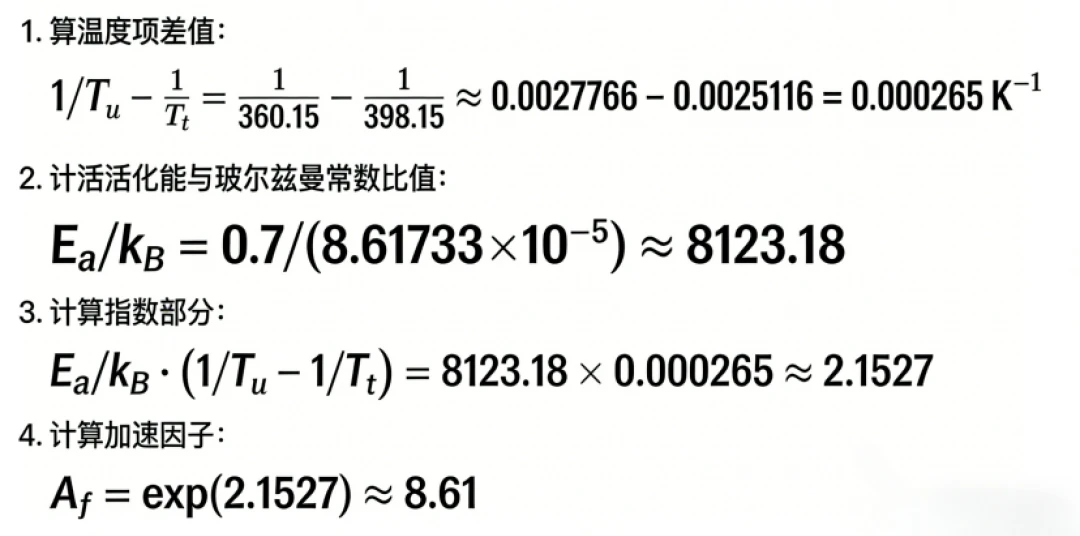
Duration of computational experiments and conclusions:
T=12000/8.61=1393 hours, therefore HTOL at 125°C requires 1393 hours.
GRGTEST Automotive Service
GRGTEST is China's first state-owned third-party testing institution listed on the stock market to achieve full AEC-Q100 automotive certification, boasting extensive experience in automotive-grade chip reliability verification. Addressing the automotive chip market, GRGTEST has established comprehensive testing capabilities for analog, digital, and sensor components, providing design enterprises with test screening and reliability testing services. The institution supports HTOL (High Temperature, Low Voltage) testing requirements for chips with power consumption ranging from 0 to 150W and various packaging architectures, while offering reliability testing covering environmental conditions, lifespan, electrical performance, and mechanical properties.