

The EU's Packaging and Packaging Waste Regulation (EU) 2025/40 replaces the outdated Directive of 1993, unifies standards across all 27 Member States, and covers five key dimensions: recyclability, recycled content, and reduction. Starting from 2030, all packaging must be recyclable; plastic packaging must progressively increase its recycled content; and single-use fruit and vegetable bags and other similar packaging forms are prohibited. Companies must leverage the 2025–2026 transition period to restructure their supply chains, with lightweight design and the use of recycled materials becoming critical competitive advantages for compliance.
GRGTEST provides testing services for European and American packaging directives, helping enterprises mitigate production risks and enhance their product quality control capabilities.
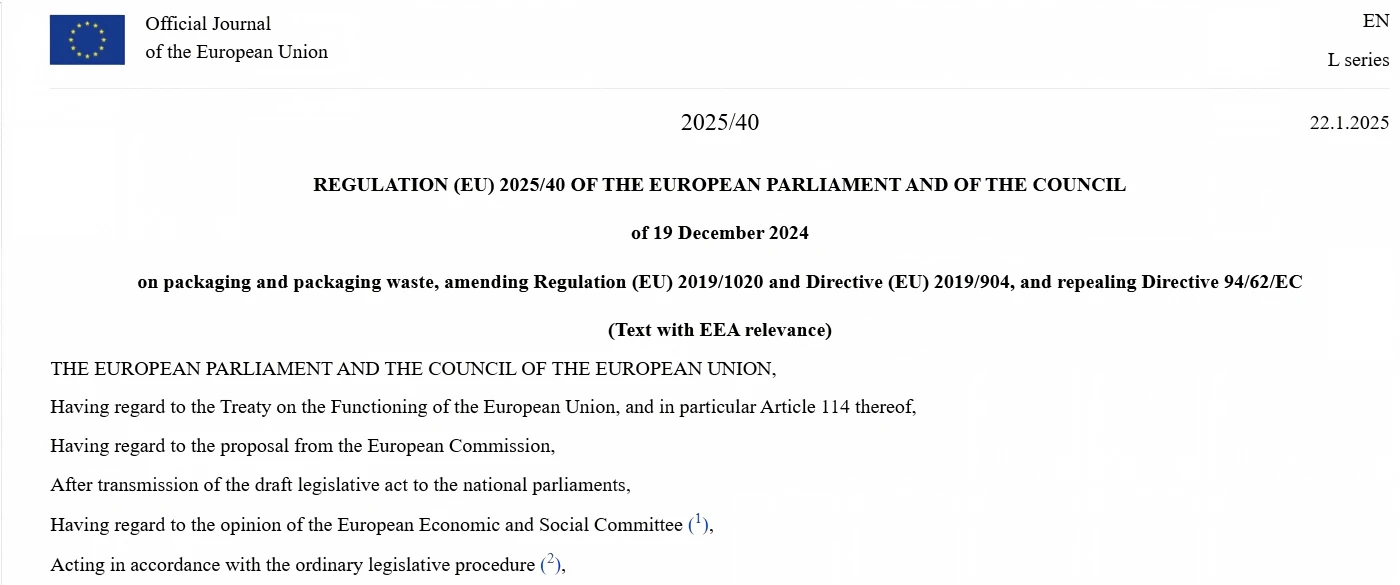
Regulation Overview
The Packaging and Packaging Waste Regulation (PPWR) - formally Regulation (EU) 2025/40 - entered into force on 11 February 2025 and will generally apply from 12 August 2026. It replaces the 30-year-old Directive 94/62/EC with a directly applicable regulation, harmonising packaging rules across all 27 Member States and eliminating regulatory fragmentation. This is the EU's most comprehensive packaging law reform in three decades.
Aligned with the European Green Deal and Circular Economy Action Plan, the PPWR covers five dimensions: recyclability, recycled content, reuse, chemical safety, and extended producer responsibility. It applies to all packaging placed on the EU market - including imported products.
Scope
The PPWR applies to all packaging and packaging waste placed on the EU market, covering:
All materials: plastic, paper/board, metal, glass, wood, composites, etc.
All levels: primary (consumer), secondary (grouped), tertiary (transport) packaging
All operators: manufacturers, importers, distributors, retailers (including non-EU companies)
Micro-enterprises (<10 employees, turnover <€2 million) face lighter obligations, but design and environmental requirements apply to all packaging without exemption.
Five Core Requirements
From 1 January 2030, all packaging must be recyclable, graded A/B/C by recoverable material share:
|
Grade |
Recoverable Material |
Market Access |
|
A |
≥ 95% |
Permitted |
|
B |
80%–95% |
Only A & B permitted from 2038 |
|
C |
70%–80% |
Phased out by 2038 |
|
Below C |
< 70% |
Banned: deemed non-recyclable |
From 2035, recyclability-at-scale assessment is added - recycling infrastructure must actually exist for the packaging format.
3.2 Mandatory Recycled Content in Plastic Packaging
Only post-consumer recycled material counts. Targets apply in two phases:
|
Packaging Category |
2030 |
2040 |
|
Single-use plastic beverage bottles (PET) |
≥ 30% |
≥ 50% |
|
Contact-sensitive – PET (excl. bottles) |
≥ 30% |
≥ 50% |
|
Contact-sensitive – other plastics |
≥ 10% |
≥ 25% |
|
All other plastic packaging |
≥ 35% |
≥ 65% |
Contact-sensitive packaging covers food, cosmetics, medical devices, and pharmaceuticals. Compliance is calculated as annual plant average.
3.3 Packaging Minimisation
Packaging weight and volume must be minimised to the extent necessary. Prohibited:
Void space exceeding 40% in e-commerce/transport packaging
Double walls, false bottoms, or other deceptive design features
Non-functional surplus packaging
3.4 Reuse Targets
|
Sector |
2030 |
2040 |
|
Cold/hot beverages (takeaway) |
20% |
80% |
|
Ready-prepared food (takeaway) |
10% |
40% |
|
Transport / grouped packaging |
50% |
90% |
|
E-commerce outer packaging |
10% |
50% |
Take-away businesses must offer bring-your-own container options at no extra cost.
3.5 Chemical Safety Restrictions
Heavy metals: lead, cadmium, mercury, hexavalent chromium ≤ 100 mg/kg (effective Aug 2026)
PFAS in food-contact packaging: individual ≤ 25 ppb; sum ≤ 250 ppb; polymer PFAS total fluorine ≤ 50 ppm
Material-Specific Recycling Targets
|
Material |
2025 |
2030 |
|
Plastic |
50% |
55% |
|
Wood |
25% |
30% |
|
Ferrous metals |
70% |
80% |
|
Aluminium |
50% |
60% |
|
Glass |
70% |
75% |
|
Paper & board |
75% |
85% |
Overall recycling rate target: 65% by 2025, 70% by 2030.
Extended Producer Responsibility (EPR) & Deposit Return Systems (DRS)
Member States must establish EPR schemes within 18 months of entry into force. Producers bear collection, sorting, recycling, and disposal costs, with fees modulated by recyclability. Single-use plastic and metal beverage containers (≤3 litres) must reach 90% separate collection by 2029; if not achieved, DRS is mandatory.
Banned Packaging Formats
From 2030, the following single-use packaging is banned:
Single-use plastic for fresh fruit & vegetables under 1.5 kg
Individual condiment/sauce sachets in hospitality
Miniature toiletry bottles in hotels
Very lightweight plastic carrier bags (unless required for hygiene/food safety)
Digital Product Passport & Unified Labelling
From 12 August 2028, all packaging must carry harmonised labels (material composition, sorting instructions, recyclability/compostability status) and a QR code linking to a Digital Product Passport. Compostable packaging must be labelled "industrially compostable".
Key Timeline
|
Date |
Milestone |
|
Feb 2025 |
PPWR enters into force |
|
Aug 2026 |
General application; heavy metal limit & PFAS restrictions take effect |
|
2027 |
Unnecessary single-use and overpackaging banned |
|
Aug 2028 |
Harmonised labelling & Digital Product Passport requirements begin |
|
Jan 2030 |
All packaging must be recyclable; Phase 1 recycled content & reuse targets apply |
|
2029 |
90% separate collection of beverage containers (DRS mandatory if not met) |
|
Jan 2035 |
Recyclable-at-scale requirement; 10% waste reduction vs. 2018 baseline |
|
Jan 2038 |
Only Grade A & B recyclable packaging permitted on EU market |
|
Jan 2040 |
Phase 2 targets apply; 15% waste reduction vs. 2018 baseline |
Business Action Points
Packaging redesign: adopt mono-material structures and separable components over multi-material laminates
Recycled content supply: partner with certified recyclers to secure post-consumer recycled plastic supply
Data traceability: build end-to-end tracking of material composition and recycled content for DPP compliance
Cost management: EPR fees and compliance costs rise, but lighter packaging can offset transport costs
Conclusion
PPWR 2025/40 replaces a fragmented directive with a unified regulation, charting a clear path toward a circular packaging economy through escalating targets on recyclability, recycled content, reuse, and waste reduction. The 2025–2026 transition window is the critical period for businesses to begin strategic adaptation - early movers will gain competitive advantage, while latecomers risk market exclusion.