


Service Content
Batteries may contain pollutants such as lead, cadmium, mercury, acid, alkali, etc. When they are discarded in the environment, they will cause varying degrees of harm to human health and the ecological environment. Therefore, the restriction of harmful substances in batteries, as well as the recycling and reuse of waste batteries, have received widespread attention from society. More and more countries are also formulating and implementing relevant policies and regulations to control harmful substances in batteries.
GRGTEST provides battery instruction control substance testing, risk assessment of battery materials, and training services for enterprise quality department and supplier control.
|
Testing content |
Testing Project |
Quantity |
Testing Cycle |
|
2006/66EC Battery Directive Testing |
2006/66EC: Pb, Cd, Hg |
5 |
5-7 working days |
Service Scope
All types of batteries and accumulators, regardless of their shape, volume, weight, material composition, and range of use.
Testing Standards
2006/66/EC, 2013/56/EU, GB 24427-2021, GB/T 20155, Federal Law 104-142.
Qualifications
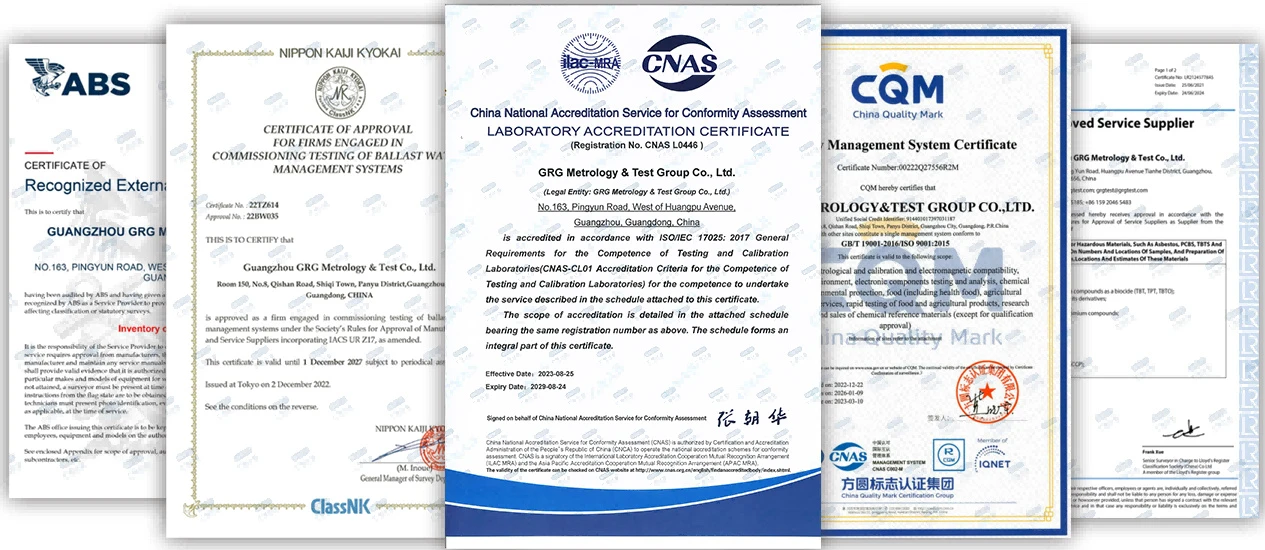
CNAS, CMA
Test Cycle
5-7 working days.
Service Background
Since 2006, batteries and accumulators placed on the EU market have been regulated by the current EU Battery Directive, but this regulation only covers the end-of-life stage, and there are currently no other legal provisions in the EU that regulate the production and use stages of batteries. Considering the changes in socio-economic conditions, technological development, market and battery usage, it is necessary to modernize this quality zero.
|
Country |
Restricted substances |
Limited requirement (homogeneous material) |
Reference regulations and standards |
|
European Union |
Lead and its compounds (Pb) |
40ppm |
2006/66/EC&2013/56/EU, RoHS directive restricts not suitable for batteries, and automotive batteries refer to 2000/95/EC |
|
Cadmium and its compounds (Cd) |
20ppm |
2006/66/EC&2013/56/EU, RoHS directive restricts not suitable for batteries, and automotive batteries refer to 2000/95/EC |
|
|
Mercury and its compounds (Hg) |
5ppm |
2006/66/EC&2013/56/EU, RoHS directive restricts not suitable for batteries, and automotive batteries refer to 2000/95/EC |
|
|
America |
Mercury and its compounds (Hg) |
(1) Prohibit the sale of mercury alkaline manganese batteries (button alkaline manganese batteries are allowed to contain no more than 25mg of mercury per battery); |
American Public Law, US Public Law 104- 142, Effective May 13, 1996 |
|
Canada |
Mercury and its compounds (Hg) |
5ppm |
Products Containing Mercury Regulations SOR/2014-254 |
|
The United Nations |
Mercury and its compounds (Hg) |
Mercury is not allowed, and the treaty annex does not cover the following products: |
The Minamata Convention on Mercury-Full Effective from August 16, 2017 |
|
China |
Mercury and its compounds (Hg) |
The work of limiting the mercury content in battery products is planned to be implemented step by step, first achieving low mercury and ultimately achieving mercury free (after 2005). The meaning of mercury free is that the mercury content in the battery is less than 0.0001% of the battery weight (i.e. 1ppm). |
Regulations on Restricting Mercury Content in Battery Products |
Our Srengths
Nationwide Service Coverage
GRGTEST is a comprehensive, state-owned third-party metrology and testing institution with a nationwide network. Its technical service guarantee network spans the entire country, and its chemical analysis laboratories are situated in six cities: Guangzhou, Wuxi, Shanghai, Tianjin, Hangzhou, and Chongqing. This makes it convenient for customers to receive testing services in their vicinity.
Recognition by authoritative institutions
GRGTEST has received recognition and authorization from numerous domestic and international authoritative institutions and organizations, boasting a highly professional technical service team.
Professional technical services
Equipped with advanced chemical analysis and testing equipment, and a team of professional talents, GRGTEST's capabilities encompass providing testing, evaluation, certification, and training services for toxic and harmful substances (such as RoHS, REACH, POPs, VOC, ozone-depleting substances, etc.), material composition and performance analysis, reliability life prediction, food contact materials, and other fields.
Provision of customized services
With comprehensive testing capabilities and extensive service experience across various industries, GRGTEST can offer tailored solutions to our clients. We assist in the green and environmental management of corporate products, ensuring compliance with legal and regulatory requirements across different countries and regions.
Common Problem
Hot Tags: battery command control substance testing, China battery command control substance testing service provider, chemical mechanical property test, chemical sulfuric acid analysis test, chemical methanol analysis test, chemical toner analysis test, chemical acetaldehyde analysis test, chemical cyclohexanone analysis test


